The history of silver is intertwined with that of gold:
Silver was already known in ancient times, and its shine made it popular, so besides gold, silver was just as popular a material for jewelry. Because of its softness, it was very easy to stretch, thin, and work, but it was easy to wear out as well. Therefore, it was usually alloyed with copper to make it more resistant. In ancient times, not only coins, but even mirrors were made from it. When only the elemental form was known for its production, the value of silver was considered equivalent to gold. The two noble precious metals were also alloyed with each other, and electrum was born from this. Today, however, the difference between their values is well understood and clear. The reason for this is that compared to gold, silver is more common in nature and can also be extracted from various chemical compounds, so its value gradually began to decrease over time. In ancient times, silver came from India, Persia, and Spain. In the Middle Ages, silver mines were opened in large numbers in Saxony and Tyrol. With the discovery of the new continent, America, silver also came to Europe from there.
We offer a wide selection of antique and modern silver artifacts, which you can view in person in our store, or buy them conveniently and safely from our online store, even in a few minutes!
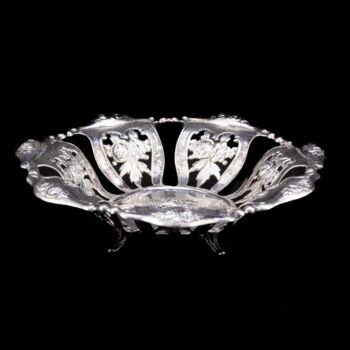
800-as finomságú ezüst, áttört kínálókosár préselt, trébelt bécsirózsás dekorral. Négy lábra helyezett kerek formájú tállal. Nettó tömege: 186 gramm. Méretei: 5 x d:18 cm. Jelzett:Pest, 1937-66 között használt fémjellel.
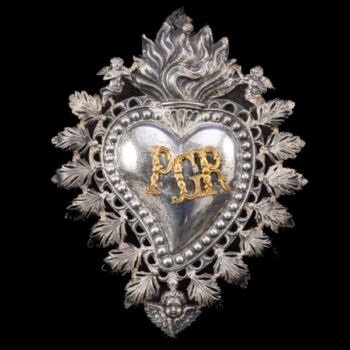
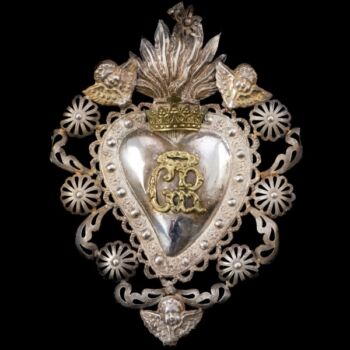
Pressed, antiqued silver heart with flames and angels, gilded PGR letters (Per Grazia Ricevuta - Received Grace) applied to the center of the heart. Net weight: 32.83 grams. Dimensions: 20 x 15.5 cm. Mid-19th century.
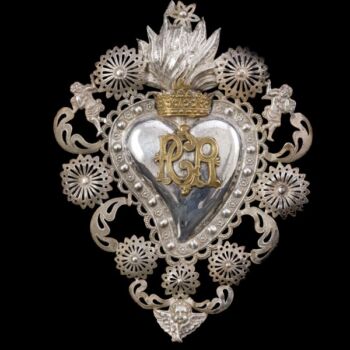
Pressed, antiqued silver heart, with a tongue of flame and full-length angels on top, leaf-like ornaments and openwork rosettes on the edges, gilded PGR letters (Per Grazia Ricevuta - Received Grace) applied to the center of the heart. Net weight: 42.05 grams. Dimensions: 24 x 18 cm. Mid-19th century.
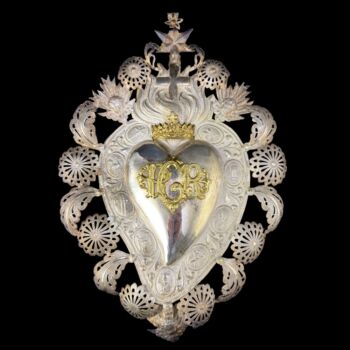
Pressed, antiqued silver heart with openwork rosettes and leaf-like decorations on the sides, flame tongue and angels on top, gilded GR letters (Grazia Ricevuta - Received Grace) applied to the center of the heart. Net weight: 28.9 grams. Dimensions: 20 x 15.5 cm. Mid-19th century.
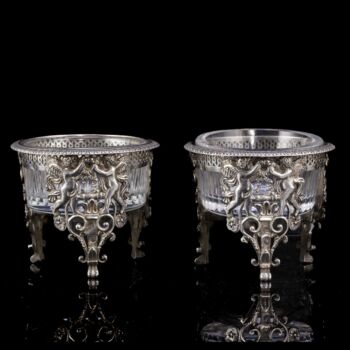
950-es finomságú, áttört ezüst, angyalpárral díszített, háromlábú fűszertartó, pótolt, hámozott mintázatú szintelen üvegbetétekkel. Méretei: 6 x d:7 cm. Nettó tömege:202,17 gramm. Jelzett:1798-1819 között használt francia fémjellel, Pierre Meurice mesterjelével.
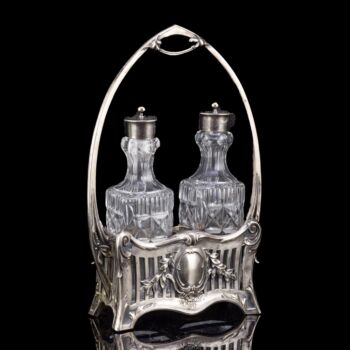
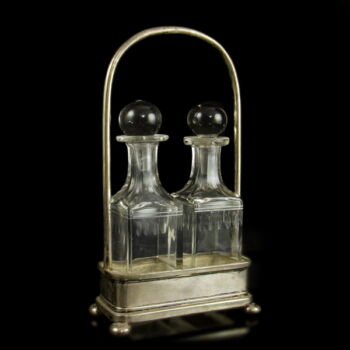
800-as finomságú ezüst olaj-ecettartó kosár, préselt szecessziós és klasszicista díszítőjegyekkel. Csiszolt kristályüveg betétekkel. Nettó ezüst tömege: 122 gramm. Méretei: 24 x 15,5 x 7 cm. Jelzett: 1888-tól használt német, hold-koronás fémjellel.
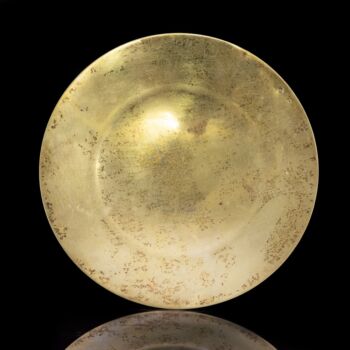
800-as finomságú, tüziaranyozott ezüst paténa, Nettó tömege: 119 gramm, méretei:d:14 cm. Alsó felének tükrében vésett IHS felirattal. Jelzett: 1867-1937 között használt pesti fémjellel.
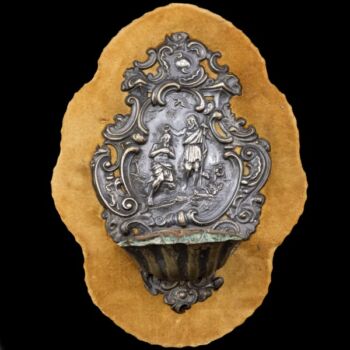
Pressed, antique silver holy water vessel applied to a shaped wooden board covered with ochre velvet. Scallop-shaped, presumably copper chalice, with a rococo-style silver relief depicting the baptism of Jesus by Saint John the Baptist. Overall dimensions: 22.5 x 16 cm. Europe, mid-19th century. Unmarked.
Polished, peeled pair of glass bottles with stoppers, with a four-ball feet base. 800 fineness silver. Net weight: 176 grams. 21 x 6 x 12 cm. Marked: German hallmark, used since 1888, with moon-crown hallmark, stamped mold number 69355, Koch and Bergfeld (from 1859- ) master's mark. Also with import hallmark from 1902-37.
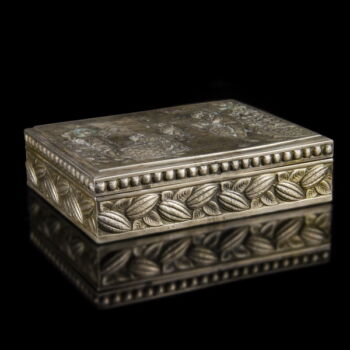
Dutch silver chocolate gift box: rectangular box of pressed, punched silver plate with insert made of natural mahogany sheets. With a still life picture of harvesting chocolate beans on the lid and a row of cocoa beans on the sides. Its wooden insert is damaged and glued at two spots. 835 'silver, Gross weight 189 grams, 3.3 x 9.5 x 11.5 cm. Marked: Dutch hallmark used until 1953.